Help
Help



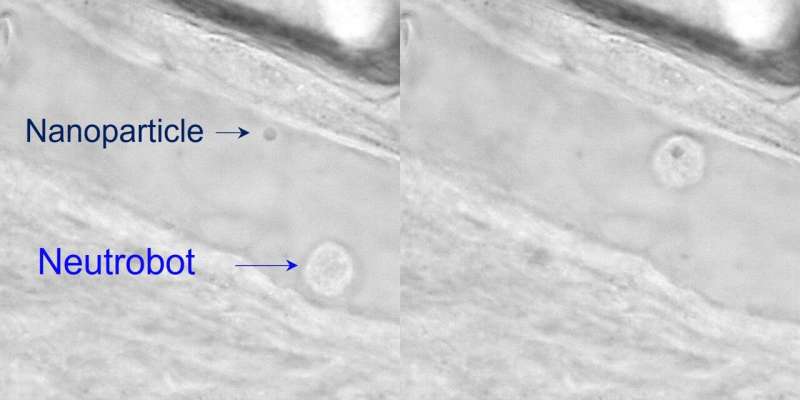
Medicinal microrobots could help physicians better treat and prevent diseases. But most of these devices are made with synthetic materials that trigger immune responses [...] researchers [...] used lasers to precisely control neutrophils—a type of white blood cell—as a natural, biocompatible microrobot in living fish. The "neutrobots" performed multiple tasks, showing they could someday deliver drugs to precise locations in the body.
[...] cells already present in the body, such as neutrophils, could be a less invasive alternative for drug delivery [...]
[...] focused laser beams as remote optical tweezers. The light-driven microrobot could be moved [...] three times faster than a neutrophil naturally moves. In their experiments, the researchers used the optical tweezers to precisely and actively control the functions that neutrophils conduct as part of the immune system. [...] a neutrobot was moved through a blood vessel wall into the surrounding tissue. Another one picked up and transported a plastic nanoparticle, showing its potential for carrying medicine. And when a neutrobot was pushed toward red blood cell debris, it engulfed the pieces.'
Turning white blood cells into medicinal microrobots with light
Though they'd still have to get the nanoparticles (of drugs etc.) into the body, assuming they're not already present....
'A boost in performance in fiber-integrated quantum memories
Quantum memories are one of the building blocks of the future quantum internet. Without them, it would be rather impossible to transmit quantum information over long distances and expand into a real quantum network. These memories have the mission of receiving the quantum information encoded in a photon in the form of qubits, storing it and then retrieving it. Quantum memories can be realized in different material systems, for example ensembles of cold atoms or doped crystals.
[...] since the entanglement was shared between a visible photon stored in the quantum memory, and one at telecom wavelengths, the team also proved that the system is entirely compatible with telecommunications infrastructure and suitable for long-distance quantum communication.'
A boost in performance in fiber-integrated quantum memories